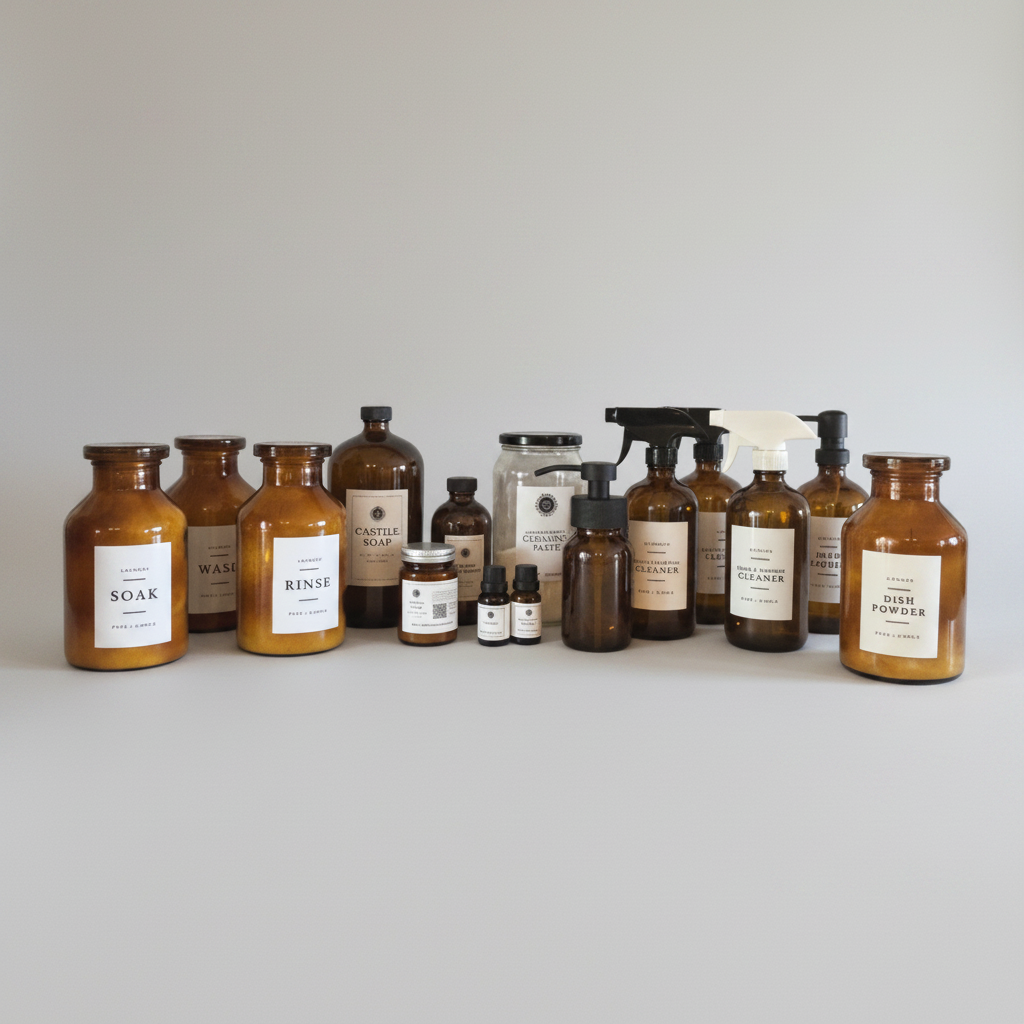
One setup. Your whole home sorted.
A complete system, not just one clever product.
Know exactly what's coming into your home.
Good enough to leave out. Practical enough to use every day.
Buy the setup once. Refill what you use.
How it works
Ready to scoop straight from the jar
One ingredient. More than one job.
Add your own water
Add your own water
Thicken as required
Thicken as required
What's in the kit
Everything has a job. Most things have several.
Laundry Wash
Ready to scoop for everyday washing.
Laundry Wash
Ready to scoop for everyday washing.
750g | Amber apothecary jar
✔️ Approx. 25 average loads per jar
✔️ Suitable for top and front loader.
✔️ Safe for homes on septic
Ingredients
Washing soda, sodium percarbonate, borax, bicarb soda and coconut soap flakes. Five, each doing a specific job: soap lifts the soil, washing soda raises the pH so it can, percarbonate handles stains, borax softens the water and bicarb deals with odour.
How much to use
- 1 teaspoon for a small load,
- 1 tablespoon for an average load,
- 2 tablespoons for large or heavily soiled.
Tips for best use
Warm to hot above 40°C works best, because heat is what activates the percarbonate. If you can only wash cold, dissolve the powder in hot water first.
Beyond the machine
- A tablespoon in a bucket of hot water makes a heavy-duty floor and surface wash
- Soak cleaning cloths and mop heads in the laundry trough overnight
- Wheelie bin, bin lids and outdoor furniture
- Rubbish-area concrete and grubby painted skirting
Keep it away from
Delicate fabrics like wool, silk and leather.
Refill with: Our hand mixed Laundry Washing Powder or make your own.
Laundry Soak
Lift stains and brighten whites without chlorine bleach.
Laundry Soak
Lift stains and brighten whites without chlorine bleach.
750g | Amber apothecary jar
✔️ Approx. 35 soaks per jar
✔️ Suitable for top and front loader.
✔️ Safe for homes on septic
Ingredient
Pure sodium percarbonate, which is washing soda and hydrogen peroxide held together in a dry, stable powder. In warm water it splits back into its two parts: the peroxide releases oxygen that breaks down the organic matter making the stain, and the washing soda lifts the pH so the oxygen can get to it.
How much to use
A tablespoon per five litres of hot water for an overnight soak. It needs warm to hot water to activate, so a cold soak will do very little..
Tips for best use
Warm to hot above 40°C works best, because heat is what activates the percarbonate. If you can only wash cold, dissolve the powder in hot water first.
Beyond the laundry
- Oven racks and grill trays, soaked in the bath or laundry trough
- Baked-on pots, roasting pans and casserole dishes
- Grout and tile build-up
- Tea towels, cloth nappies and dull whites
- Outdoor furniture, pavers and shade sails
- Stirred into the Cleaning Paste when a job pushes back
Keep it away from
Delicate items lik wool, silk and leather.
Refill with: Sodium Percarbnate
Laundry Rinse
Clear away alkaline residue and hard-water build-up.
Laundry Rinse
Clear away alkaline residue and hard-water build-up.
650g | Amber apothecary jar
✔️ Around 50 rinse loads, or a great many spray bottles, depending on how you use it.
✔️ Suitable for top and front loader.
✔️ Safe for homes on septic
Ingredient
Pure citric acid. Nothing else. It works like vinegar, without the smell and without a plastic bottle, and it stores dry with an indefinite shelf life.
How much to use
One teaspoon per 500ml of water. That single ratio is the starting point for almost everything below
Beyond the laundry
- Fabric softener, straight into the rinse compartment
- Dishwasher rinse aid, for glasses that dry clear
- Glass and window spray
- Shower screen and soap scum spray
- Toilet gel, once thickened with the glycerine and xanthan gum
- Kettle, coffee machine and showerhead descaler
- Taps, chrome and stainless fittings
Keep it away from
Natural stone including marble, travertine, limestone and granite, because acid etches it permanently. Also brass, copper, bronze, aluminium, wool and silk. Do not mix it with the Castile Soap in the same bottle, they cancel each other out.
Refill with: Citric Acid
Dishwasher Powder
Ready to scoop for everyday washing.
Dishwasher Powder
Ready to scoop for everyday washing.
750g | Amber apothecary jar
✔️ About 30 dishwasher loads.
Ingredient
Washing soda and sodium percarbonate. Two. The washing soda cuts the grease and the percarbonate uses oxygen to break down food residue, which is the part doing the heavy lifting in most commercial tablets too.
How much to use
Roughly one tablespoon in the detergent compartment. Do not overfill, more powder does not mean cleaner dishes. Hot cycles give more reliable results than eco or short washes. Pair it with a citric acid rinse aid in the rinse compartment and your glasses dry clear.
Beyond the dishwasher
- Fill the sink with hot water and a scoop to soak pots and roasting pans
- Cloudy vases, thermos flasks and travel mugs
- Oven racks in the laundry trough
- A laundry stain soak in a pinch, it shares two ingredients with the Laundry Wash
- The inside of the kitchen bin
Keep it away from
Anything not dishwasher safe, and aluminium.
Refill with: Premixed Dishwasher powder or mix your own
Cleaning Paste Mix
Just add boiling water to the jar
Cleaning Paste Mix
Just add boiling water to the jar
300g in 1L heatproof jar suitable for hot filling
✔️ Makes 1L of paste
Ingredients
Washing soda, borax and coconut soap flakes. Three. It is an old recipe that produces something close to the tub of scrubbing cream you grew up with, minus the fragrance and the plastic.
How to make it
Boiling water straight into the jar, stir, leave it to set. That is the whole recipe. Give it a whip the next morning if you want it lighter.
Where you can use it
- Bath, shower base and shower screen
- Grout, and the corners a spray runs straight off
- Oven door glass, stovetop and range hood
- Stained sinks and scuffed skirting boards
- Rubbed directly onto collars, cuffs and food stains before a wash
- Outdoor furniture, car wheels and eskies
Tip
Add a teaspoon of your Laundry Soak and a dash of water when a job needs more than scrubbing. The percarbonate activates in the paste and does the lifting for you.
Keep it away from
Anything not dishwasher safe, and aluminium.
Refill with: Cleaning Paste Mix or make your own
Castile Soap
For surface sprays, dish liquid, hand and body wash
Castile Soap
For surface sprays, dish liquid, hand and body wash
1 litre in amber glass jar
✔️ At roughly 25ml per spray bottle, one litre makes dozens of refills.
✔️ Handmade in Australia by a social enterprise.
Ingredients
A true liquid soap made from 80% olive oil and 20% coconut oil, saponified with potassium hydroxide. The olive oil gives it the mild character Castile is known for, the coconut adds cleansing and lather. The alkali is consumed during saponification, so no lye remains in the finished soap. It is a surfactant, which simply means one end of the molecule grabs oil and the other grabs water, so grease can be rinsed away rather than smeared around.
Where you can use it
- All-purpose bench spray, the one you reach for most
- Dish liquid at the sink, thicker with a little glycerine and xanthan gum
- Foaming hand and body wash
- Floors and the mop bucket
- Wool and delicates wash, where the powders cannot go
- Car, outdoor furniture and pet wash recipes
Tip
The one thing worth learning early: soap and acid cancel each other out. Never put Castile and citric acid in the same bottle. Soap first to lift the grease, acid afterwards for the mineral film. In that order they are excellent. Together they are neither.
Refill with: Castile Soap
Thickeners
Glycerine and xanthan gum to turn your sprays into gels
Thickeners
Glycerine and xanthan gum to turn your sprays into gels
250ml vegetable glycerine in amber glass bottle and 80g xanthan gum in amber glass jar
✔️ Both are used in small quantities, so these last a long time.
✔️The technique for turning any water-based spray into a gel that stays where you put it
Why they come as a pair
Xanthan gum thickens water, but tip it straight into water and it clumps instantly into little jellied lumps that never dissolve. The fix is to stir it into the glycerine first. Glycerine is not water, so the powder cannot start hydrating in it. The glycerine coats every particle and keeps them separate, so when that slurry hits the water each particle hydrates on its own and you get a smooth gel. That one step is the difference between a professional-looking cleaner and a bottle of lumps.
What thickening is for
- Toilet gel, so the citric acid clings under the rim long enough to work
- Shower and screen gel, instead of a spray that runs to the floor
- A thicker sink-side dish liquid that does not disappear down the plughole
- A clinging oven cleaner that stays on a vertical door
- Keeping ingredients suspended so a bottle needs less shaking
Glycerine also has a job of its own. It is a humectant, which means it holds moisture, so a small amount in a hand wash or dish liquid makes it feel less stripping on your hands.
Refill with: Both are sold separately in several sizes. Most people replace the xanthan gum long after the glycerine.
Natural Fragrance
Only add of and when you want
Natural Fragrance
Only add of and when you want
Lemon 15ml and Eucalyptus Blue Gum 15ml, pure, sealed, in amber glass.
Everything else in the kit is fragrance free as supplied, so these two are the only scent in the box and they only go where you put them.
Where they go
- A few drops into the wash, or into the laundry powder jar
- Into the mop bucket, eucalyptus is the traditional one for floors
- Into a bench spray or a foaming hand wash
- Lemon neat on sticky label residue, price tags and adhesive gunk
- A drop on a cloth inside the bin before the liner goes in
Oil and water separate, so a spray with essential oil in it needs a shake before every use. A small amount of Castile Soap in the same bottle helps disperse the oil and keeps it more even.
Refill with: 15ml or 50ml. Lemongrass and Sweet Orange are also available if you want to change the house smell.
Amber Glass Spray Bottles
One for the kitchen bench, one under the bathroom sink, one for glass and windows.
Amber Glass Spray Bottles
One for the kitchen bench, one under the bathroom sink, one for glass and windows.
Three 500ml amber glass spray bottles with black triggers.
Specifications
- Capacity 500ml, pharmaceutical grade amber glass
Why amber and why glass
Amber glass blocks UV light, which matters the moment there are essential oils in the bottle. Glass does not stain, does not hold onto odour, does not go cloudy or brittle, and does not need replacing when you change what is in it. Mixing trigger colours across your bottles is the easiest way to tell a soap spray from an acid spray at a glance, which matters because the two should never be swapped.
The labels
Waterproof, professionally printed and designed to look like something you would leave on the bench.
Soap Dispenser bottles
For the kitchen and bathroom
Soap Dispenser bottles
For the kitchen and bathroom
A 250ml foaming pump bottle for hand and body wash, and a 500ml pump bottle with a stainless steel pump for dish liquid at the sink.