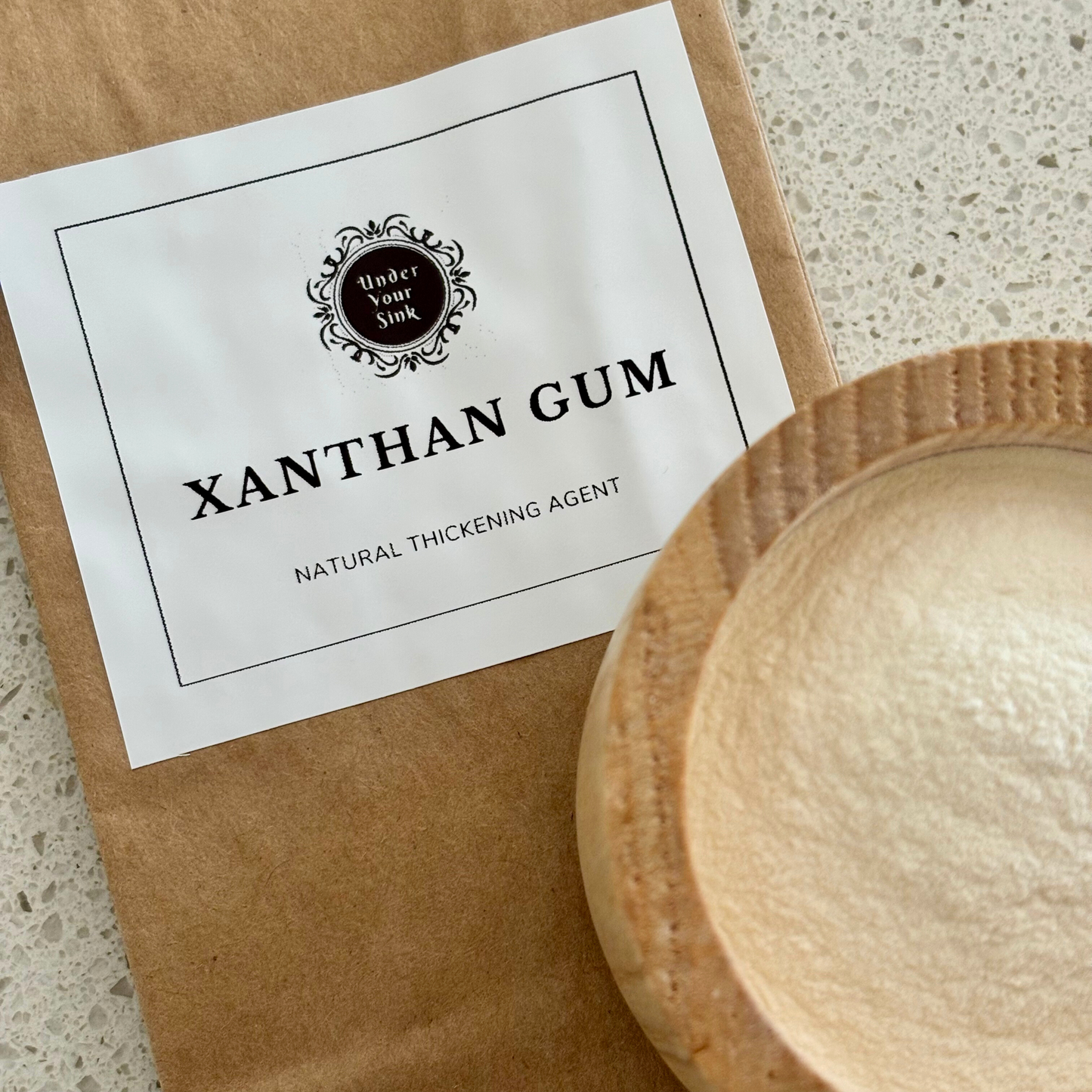

Xanthan gum is all about texture, cling, and consistency, especially in water-based DIY products.
Most DIY cleaning ingredients do the actual cleaning. Xanthan gum is what turns a watery liquid into something that actually stays where you put it.
What it is
Xanthan gum is a natural ingredient that thickens liquids when mixed with water. In powder form it looks unremarkable. Added to water, it turns a runny solution into a smooth, consistent gel.
It doesn't clean on its own. It has no antibacterial, descaling, or degreasing action. Its job is to support the other ingredients in a recipe by improving how a product looks, feels, and performs.
How it's made
Xanthan gum is produced through bacterial fermentation.
The bacterium is fermented with a sugar source and during fermentation. That xanthan gum is then recovered dried, and milled into the fine white powder you'll use in recipes.
The process is natural in the sense that it uses a biological organism and plant-based sugar inputs rather than petroleum chemistry. It is also a controlled industrial process with real inputs and waste streams, which is worth knowing if you're thinking carefully about the full picture.
What it's used for
In DIY cleaning and personal care products, xanthan gum:
- thickens water-based recipes into gels or smooth liquids
- helps products cling to surfaces rather than running straight off
- helps keep ingredients evenly mixed throughout a product
- gives hand washes, dish liquids, and gels a texture that feels like the commercial versions people are used to
It's particularly useful when contact time matters. A shower gel cleaner that stays on a tile for thirty seconds works better than one that slides to the drain in five. Xanthan gum is what gives you that control.
Used in these recipes
Storage and shelf life
Stored correctly, xanthan gum has a shelf life of around two to three years.
The main enemy is moisture. Even small amounts of humidity can cause the powder to clump, partially hydrate, and begin to degrade before you use it. Once that happens, it won't mix cleanly into your recipes.
How it works best with glycerin
If you've tried adding xanthan gum directly to water and ended up with lumpy clumps that wouldn't fully dissolve, you've experienced one of its most common DIY frustrations.
Here's what's happening: xanthan gum hydrates very quickly on contact with water. The outside of each particle swells and gels before the inside has a chance to absorb water too. The result is a cluster of gel-coated powder with a dry centre, which is difficult to break down no matter how hard you stir.
The fix is glycerine.
Before adding xanthan gum to water, mix it thoroughly with glycerin first. Glycerin is a humectant and viscous liquid, but it isn't water, so the xanthan gum particles don't start to hydrate in it. Instead, the glycerin coats each particle and keeps them separated. When you then add that mixture to water, the xanthan gum particles hydrate individually and evenly, giving you a smooth, lump-free gel.
The ratio doesn't need to be precise, but roughly one part xanthan gum to three or four parts glycerin works well as a starting point before adding it to your water phase.
Eco profile
Xanthan gum is biodegradable, vegan-friendly, and septic-safe. It's produced through fermentation rather than petroleum-derived chemistry, and it works in very small quantities, which limits the volume needed per product.
It fits well into low-waste households and is suitable for products that go on your body or down the drain.
As with most ingredients, the full picture includes the inputs to the fermentation process and the industrial production involved. The point isn't that xanthan gum is perfect. It's that it's a well-understood ingredient with a reasonable profile that serves a real function in DIY formulation.