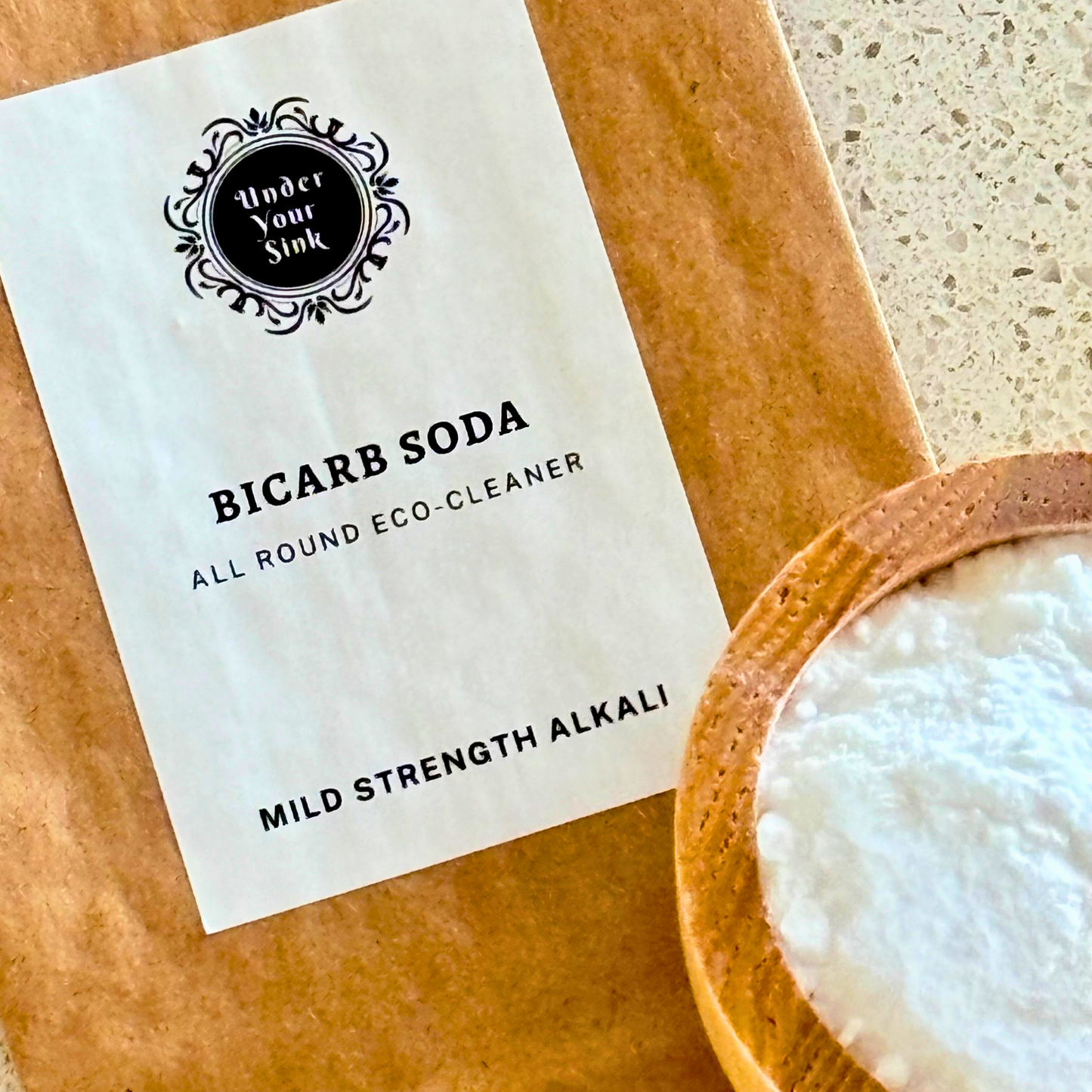

Bicarb soda is probably the most familiar ingredient in the green cleaning toolkit and also the most misunderstood.
Most people already have it in the cupboard. Many use it regularly. The issue is not that it does not work. It is that it is often expected to do far more than it was designed to do.
Once you understand what bicarb is genuinely good at (and where it runs out of steam) it becomes a reliable, sensible ingredient rather than a frustrating one.
What it is
It is a fine white powder with a slightly silky texture, noticeably different from the grittier feel of washing soda or the crystalline texture of borax. It dissolves easily in water and is one of the safest cleaning ingredients available.
Its pH in solution is around 8.3, which makes it mildly alkaline and the gentlest of the three alkaline cleaning ingredients.
Bicarb soda is sodium bicarbonate. Its chemical formula is NaHCO₃.
A note on the names
Bicarb goes by several names and the variation causes more confusion than it should:
- Bicarb soda: the common Australian term
- Baking soda: the American term
- Bicarbonate of soda: the British term
- Sodium bicarbonate: the scientific/IUPAC name
All four refer to exactly the same compound: NaHCO₃. You can buy any of them and use them interchangeably in cleaning recipes.
It is not baking powder!
Baking powder is a different product. It's a mixture of bicarb, an acidic ingredient (usually cream of tartar) and a starch to prevent premature reaction. Baking powder can make cakes rise on its own; bicarb requires an acid to produce the same effect. In cleaning, baking powder is not a substitute for bicarb.
The science of how it cleans
Bicarb cleans through a combination of mild alkalinity, a unique chemistry called amphoterism (means a substance can behave in two different ways, depending on what it is mixed with) and gentle physical abrasion.
Mild alkalinity: At pH 8.3, bicarb creates a slightly alkaline environment that can loosen light grime and surface residue. It is not strong enough to break down heavy grease or tackle serious build-up, but for light everyday cleaning it does a reasonable job.
Amphoteric behaviour: This is the property that makes bicarb so useful for deodorising. An amphoteric compound can react with both acids and bases. Most household odours are either acidic (sour smells, food odours, sweat) or alkaline (ammonia, fish, some pet smells). Bicarb neutralises both, which is why it works across such a wide range of odour problems, not just masking the smell but chemically neutralising the source.
Gentle abrasion: The fine crystals provide enough texture to scrub light stains and surface marks without scratching most materials. This is the "elbow grease" of bicarb, not chemistry, just physics. It is why bicarb pastes work well on taps, sinks and soft surfaces where you want to scrub without causing damage.
What happens when it meets acid: When bicarb contacts an acid (vinegar, citric acid, lemon juice) it reacts and produces carbon dioxide gas. That is the fizz. It is a neutralisation reaction: the acid and the bicarb cancel each other out. The fizz is visually satisfying, but what remains after it settles has very little cleaning power. More on this below.
Its relationship with borax and washing soda
Bicarb is the first of the alkaline trio, the three white powders that do the heavy lifting in DIY green cleaning. They look similar, show up in similar recipes, and cause constant confusion.
The simplest way to think about them is by strength:
| Washing Soda | pH ~11 | Heavy grease, hard water, deep cleaning |
| Borax | pH ~9.5 | General cleaning, mould inhibition, laundry boosting |
| Bicarb Soda | pH ~8.3 | Gentle deodorising, light cleaning, baking |
Bicarb is the gentlest, mild enough to use on skin, in a bath, in baking, or sprinkle in the fridge. Excellent at deodorising. Not designed to cut grease or replace stronger cleaners.
Note: Often a mix of the three is a perfect solution along with soap as your surfactant
These ingredients are not interchangeable in recipes. A recipe written for washing soda will not produce the same result with bicarb in its place and definitely never use washing soda for baking a cake!
Used in these recipes
Bicarb is found in the following handmade recipes
Where bicarb runs out of steam
Bicarb is not designed to cut heavy grease, replace proper dishwashing or laundry products, disinfect surfaces, or deal with hard water build-up. When it is asked to do these jobs, it will disappoint and people often blame green cleaning rather than recognising that the wrong ingredient is being used.
The bicarb and vinegar question
One of the most widespread green cleaning habits is mixing bicarb and vinegar together.
The fizz looks impressive, which makes it feel powerful. What is actually happening is a neutralisation reaction. The acetic acid in vinegar and the alkalinity of bicarb cancel each other out. The result is CO₂ (the fizz), water and sodium acetate.
Once the fizz settles, most of the cleaning ability of both ingredients has been consumed in the reaction.
Bicarb and vinegar both have useful roles — just not together, and not for everything!
Bicarb is best for deodorising and gentle scrubbing. Vinegar is best for mineral deposits, descaling and glass. Used separately and deliberately, both work well. Mixed together, each cancels out what makes the other useful.
What you can use it on
Bicarb is one of the most forgiving cleaning ingredients available. It is safe on a very wide range of surfaces:
- Hard surfaces: tiles, ceramic, porcelain, glass, most plastics
- Sinks, baths and showers
- Carpets and rugs (deodorising)
- Upholstery and soft furnishings (spot treatment and deodorising)
- Inside fridges, bins and other appliances
- Used in bath bombs, scrubs and toothpaste
What to avoid
Bicarb is gentle enough that the list of surfaces to avoid is shorter than for washing soda or borax.
- Natural stone such as marble, travertine and limestone
- Aluminium
- Delicate items like silk and wool
Storage and shelf life
Store bicarb in a sealed, airtight container in a cool, dry location. Moisture causes clumping and can trigger partial reactions that reduce effectiveness over time.
Kept dry and sealed, bicarb has an indefinite shelf life. If it has clumped, it can usually be broken up and used normally.
History
Bicarb has a shorter commercial history than washing soda, but its roots go back just as far.
Ancient Egyptians used natron (a naturally occurring mixture of sodium carbonate and sodium bicarbonate found around dry lake beds) for mummification, cleaning, glassmaking and food preservation. Bicarb was not isolated as a distinct compound until the era of modern chemistry.
The Solvay process (1861) made large-scale synthetic production of sodium carbonate economical, and bicarb follows from that: sodium carbonate can be treated with CO₂ and water to produce sodium bicarbonate. This synthetic route still supplies most of the world's commercial bicarb.
In the United States, Arm & Hammer began selling bicarb as a consumer product in 1846. In Australia, bicarb became a kitchen and household staple through the late 19th and 20th centuries alongside the growth of commercial baking.
The ingredient in the bag under your sink has been used in households, in various forms, for generations.
Eco credentials
Bicarb is one of the most environmentally benign cleaning ingredients available.
When it breaks down in water, it produces sodium ions and bicarbonate ions, both naturally occurring compounds found in rivers, oceans and biological systems. It is fully biodegradable, safe for drains, greywater systems and septic tanks.
It is non-toxic, food-safe, and produces no harmful byproducts in normal household use. Because it deodorises effectively, it reduces the need for synthetic fragrances and single-use deodorisers.
Its mildness also means it is one of the few cleaning ingredients that works on soft surfaces, textiles and skin-safe applications.
Synthetic vs naturally sourced
Most commercial bicarb is produced synthetically via the Solvay process, which uses salt, ammonia and CO₂ in a chemical reaction. This is the same process used to produce washing soda synthetically, with an additional CO₂ step to convert the resulting sodium carbonate into sodium bicarbonate.
Naturally sourced bicarb comes from trona ore, the same naturally occurring mineral that yields natural washing soda. Trona contains both sodium carbonate and sodium bicarbonate naturally, and processing separates them. The main deposits are in Wyoming (United States) and Turkey.
From a cleaning perspective, both are chemically identical. The difference is in the production footprint: naturally mined bicarb requires less energy-intensive chemical processing, making it the more sustainable option where available.
At Under Your Sink, we stock naturally sourced bicarb soda