About Citric Acid
Analisa Malone
Most people know vinegar as the acidic ingredient in green cleaning. What fewer people realise is that citric acid does the same job, often better, and without the smell.
What it is
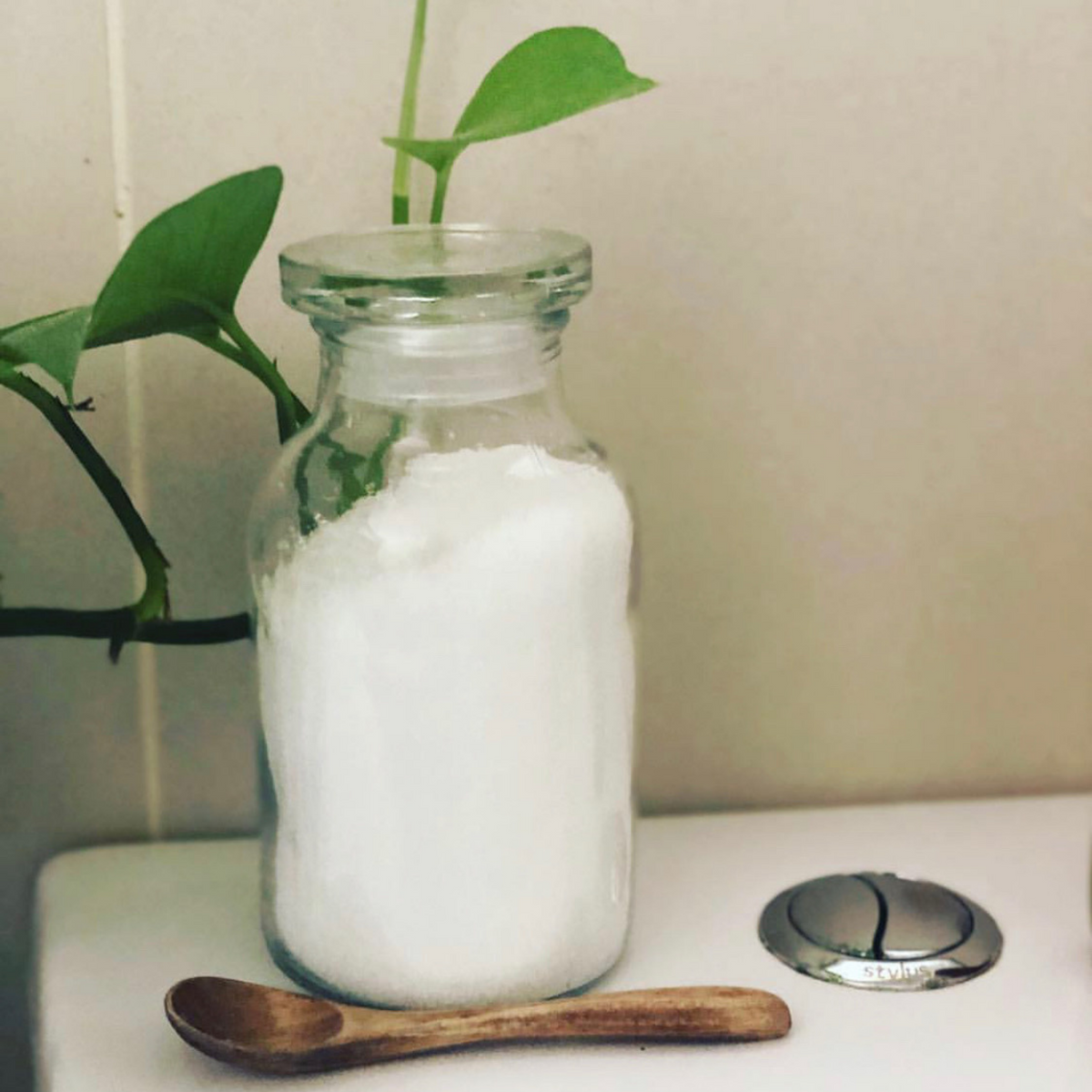
In cleaning, it appears as a fine white crystalline powder or granules. It dissolves easily in water and has a pH of around 2 to 3 in solution, making it meaningfully acidic without being aggressive or corrosive in the way that industrial acids are.
It is food safe, classified as E330 in Australia, and used widely in food, beverages, cosmetics and pharmaceuticals as well as cleaning.
The science of how it cleans
Citric acid works through three distinct mechanisms, which together make it very useful as a finishing and descaling ingredient.
It dissolves limescale: Limescale is primarily calcium carbonate, the white crusty deposit left behind when hard water evaporates. Citric acid reacts with calcium carbonate and converts it into calcium citrate, which dissolves in water and can be rinsed away. This is why citric acid is so effective on kettles, taps, shower heads and toilet bowls. You are not scrubbing the limescale off you are chemically dissolving it.
It chelates minerals: Citrate ions (the dissolved form of citric acid) are excellent chelating agents, meaning they bind to calcium and magnesium molecules in hard water and hold them in solution. This prevents them from depositing on surfaces, from reacting with soap to form scum, and from leaving the cloudy film that is the main complaint about hard water. This is why citric acid works so well as a rinse aid and fabric softener. Although it is not softening the fabric, it is neutralising the mineral interference that was making the fabric feel stiff.
It neutralises alkalinity: The other ingredients in the system (washing soda, borax, bicarb, castile soap) are all alkaline. They do a great job of lifting grease and grime, but alkaline residue left on surfaces or in fabrics can cause dullness, stiffness and build-up. Citric acid neutralises that residue. Think of it as the rinse cycle for your cleaning system.
If the alkaline ingredients do the washing, citric acid does the rinsing.
Used in these recipe
- Window and glass spray
- Fabric softener
- Dishwasher rinse aid
- Toilet cleaning gel
- Shower Cleaner
- Floor cleaner
Kettle descaling (no recipe needed): Dissolve 1 teaspoon of citric acid in a full kettle of water. Boil, leave for 10-15 minutes, then rinse thoroughly two or three times before using again.
Citric acid vs vinegar
These two do very similar jobs. Both are acidic, both dissolve limescale, both neutralise alkaline residue.
The difference is form and concentration. Citric acid is odourless, more concentrated, and far more convenient to store. A small bag takes up almost no space and lasts a long time because you use such small quantities. There is no smell and no bulky bottles.
Vinegar is more accessible for people just starting out and works well for some jobs. But if you find the smell unpleasant, or you want a cleaner that is easier to dose and store, citric acid is the better option.
What you can use it on
- Stainless steel or chrome taps, sinks and shower fittings
- Glass and windows
- Ceramic and porcelain (toilets, basins, tiles)
- Plastic kettles and coffee machines
- Most washable fabrics (as a rinse aid, not a direct treatment)
- Grout (light limescale and mineral deposits)
- Dishwasher interior
What to avoid
Citric acid is an acid. Used on the wrong surfaces it will cause permanent damage.
- Natural stone such as marble, granite, travertine, limestone
- Acid-sensitive metals such as brass, copper and bronze
- Grout in poor condition
- Wool, silk and delicate fabrics
- Aluminium
Do not mix with alkaline ingredients unless making bath bombs, thats it! Mixing citric acid directly with washing soda, bicarb or soap in solution neutralises both. They work best used separately or in recipes specifically designed to combine them (like dishwasher tablets, where the acid and alkaline are in separate phases).
When in doubt, test on a small, hidden area first.
Storage and shelf life
Citric acid is one of the easiest ingredients in the kit to store. Keep it in a sealed, airtight container in a cool, dry location and it has an indefinite shelf life. Moisture is the only real concern, humidity can cause it to clump, though this does not affect its effectiveness.
If it has clumped, break it up and use as normal. If it has absorbed significant moisture and turned sticky, it has started to react with the humidity in the air and may have lost some potency.
Keep it clearly labelled. It looks similar to washing soda and sodium percarbonate, and mixing them up matters.
How it is produced and why it is not from citrus rinds
This surprises most people. Despite being called citric acid, and despite being found naturally in lemons and limes, almost none of the citric acid produced commercially today comes from citrus fruit.
The first industrial production of citric acid in the late 1800s did use citrus fruit, mainly lemons from Sicily, which were squeezed and processed to extract the acid. But this was expensive, slow and heavily dependent on harvest conditions.
In 1917, an American chemist named James Currie discovered that a common mould (Aspergillus niger) could produce citric acid in large quantities when fed on simple sugars. By 1919, Pfizer had commercialised the fermentation process and citrus-based production became economically unviable almost overnight.
Today, virtually all citric acid is produced through fermentation. The end product is chemically identical to the citric acid in a lemon. It is just made through a more efficient and scalable biological process rather than by squeezing fruit.
This is worth knowing because people sometimes assume commercial citric acid is a synthetic chemical. It is not, it is the product of a natural fermentation process, and it is the same molecule regardless of whether it came from a mould culture or a lemon grove.
Eco credentials
Citric acid is one of the most environmentally benign cleaning ingredients available. When it breaks down in water, it degrades into carbon dioxide and water, no persistent compounds, no accumulation in the environment.
It is biodegradable, food safe, septic safe and generally considered safe for greywater systems at normal household concentrations. Its acidity dissipates quickly once diluted, so it does not linger in waterways.
Because it is highly concentrated, you use very small quantities for most jobs. A teaspoon to descale a kettle, a tablespoon in a batch of dishwasher powder. That means less packaging, less product moving through your home, and less going down the drain.