About Castile Soap
Analisa Malone
Most of the ingredients in the Under Your Sink kit are powders. Castile soap is the exception.
It is a liquid and is here to do what soap has always done: lift dirt, oils and grime from surfaces and skin so they can be rinsed away.
It is also the most versatile ingredient in the kit. The same bottle that washes your hands goes into your dish liquid recipe and your all-purpose spray.
What it is
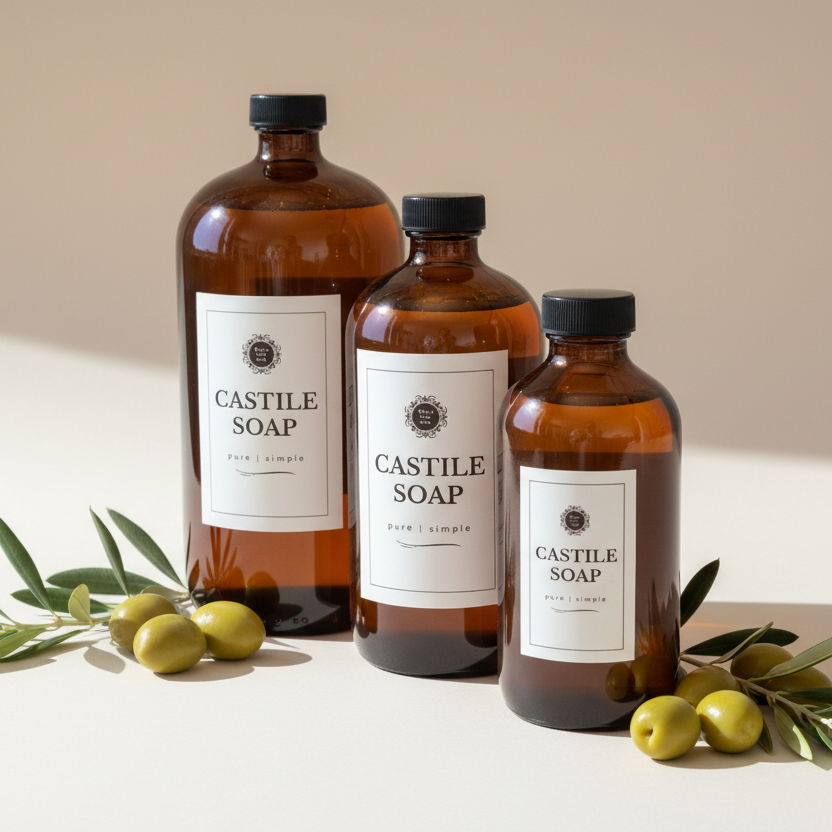
Castile soap is a true liquid soap made from olive oil.
It is not a detergent. This distinction is worth understanding, because most commercial "soaps" are actually synthetic detergents. They look and feel like soap, but they are made from petroleum-derived surfactants rather than saponified oils.
Castile soap is a true soap: the oil and lye have undergone a chemical reaction that converts them entirely into soap and glycerine. There is no lye remaining in the finished product.
The glycerine is important too. In commercial soap and detergent manufacturing, glycerine is often removed from the final product and sold separately. In genuine Castile Soap, it stays and is what gives the soap its moisturising quality and makes it gentle enough to use on skin.
To be classified as a true Castile soap, olive oil must make up at least 80% of the oil base. The coconut oil contribution is typically small, it adds lather and a slightly firmer structure to the formula.
The finished product is a clear or slightly amber liquid that dissolves easily in water and lathers well.
Its pH is around 9 to 10, alkaline, which is correct for a soap. This is worth knowing because it affects what you can and cannot mix it with (more on that below).
The version stocked at Under Your Sink is made from four ingredients: 80% olive oil, 20% coconut oil, filtered rainwater, and potassium hydroxide (lye).
How it is made
Castile soap is made through a process called saponification. Oils and fats are combined with a strong alkali which breaks the chemical bonds in the oil molecules forming soap.
The specific alkali used determines the form of the soap:
- Potassium hydroxide (KOH) produces a soft or liquid soap.
- Sodium hydroxide (NaOH) produces a hard bar soap.
This is why liquid castile soap and bar castile soap, while closely related, are chemically distinct products. The starting oils may be the same, but the finished soap salts are different compounds.
No lye remains in the finished product. The saponification reaction consumes it entirely.
How it cleans
Castile soap is a surfactant which literally traps and lifts dirt so it can be washed away in rinses water.
Soap molecules have two distinct ends. One end is attracted to water (hydrophilic). The other end is attracted to oils and fats (hydrophobic). When soap meets water and a greasy surface, the oil-loving ends cluster around the grease and the water-loving ends face outward. This forms tiny spherical structures called micelles: grease trapped inside, soap on the outside. The micelles stay suspended in water and rinse away cleanly.
Without soap, water alone cannot clean oily surfaces. Water is hydrophilic, it repels oil rather than mixing with it. Soap bridges that gap.
The hard water issue
There is a limitation worth knowing about. In hard water, calcium and magnesium molecules react with soap to form the familiar grey film called soap scum. This is not a failure of the soap; it is a chemistry problem caused by the water.
This is one reason why the alkaline trio appears in laundry recipes alongside castile soap. Washing soda and borax soften the water by binding to those calcium and magnesium ions before they can interfere with the soap. The soap then does its job properly, and you do not end up with residue on fabrics or surfaces.
If you are using castile soap in a hard water area and noticing a film, adding a small amount of washing soda or borax is usually the fix.
Used in these recipes
- All-purpose soap spray
- Wool and delicates wash
- Dishwashing liquid
- Hand wash
- Soap wash for people and pets
Add it to water to make a soapy solution that can clean cars, windows, outdoor areas.
Storage and shelf life
Castile soap is straightforward to store, with one quirk worth knowing about.
Because our Castile soap has a high olive oil content, it can go cloudy or develop white sediment when temperatures drop below about 15°C. This is completely normal, the cloudiness you see is simply the oil responding to the cold. It does not affect the quality or effectiveness of the soap. As soon as the temperature rises again, it clears.
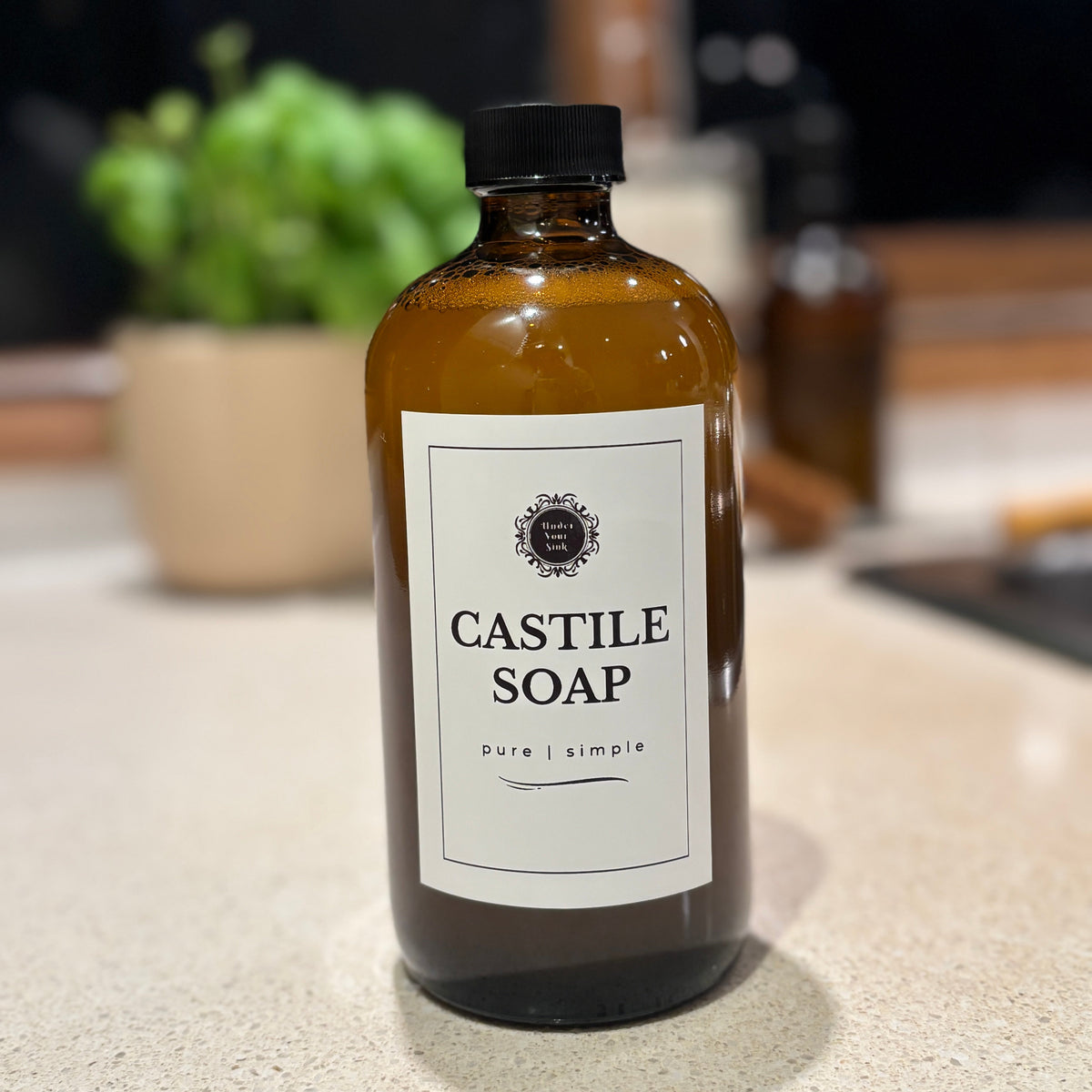
Store in a cool, stable location away from direct sunlight and extreme heat. Amber glass bottles provide good UV protection, which is useful because prolonged light exposure can degrade the oil components over time.
Shelf life is typically around 3 years unopened and 12-18 months once opened, depending on storage conditions.
History
The story of Castile soap begins not in Spain but further east.
Soap makers in the Levant (the region covering modern Syria, Lebanon and surrounding areas) have been making hard soaps from olive oil and laurel oil for thousands of years. Aleppo soap, made in the ancient Syrian city of the same name, is thought to be one of the oldest manufactured soaps in the world.
What made the Castile region of Spain particularly notable was a combination of two things: abundant olive oil and an unusually good local alkali.
Castile soap became a luxury item during the Middle Ages. It was used by royalty and the wealthy, valued for its purity and gentleness at a time when most soap was rough, dark and smelled strongly of tallow. It was traded across Europe, and the name 'Castile' (after the Crown of Castile) became a mark of quality.
The name later became a general term for any pure olive oil soap made in this style, regardless of where it was produced. Today it covers a broader range of plant oil formulas, but the quality standard genuine soap, plant-based oils, no synthetics.
Eco credentials
Castile soap has a straightforwardly good environmental profile.
The fatty acid salts that make up soap are biodegradable. They break down readily in soil and water into simple compounds, and they do not accumulate in the environment or in aquatic organisms the way that many synthetic surfactants can.
Because it is made from plant oils rather than petroleum feedstocks, the ingredients are renewable. The production process (saponification) is a simple chemical reaction without the complex synthesis steps required for most synthetic detergents.
The natural glycerine retained in the finished soap is also worth noting from an environmental perspective. In commercial soap and detergent production, glycerine is typically extracted and sold as a separate commodity. Keeping it in the soap means one less industrial processing step, and a better product for your skin.
No synthetic fragrances, preservatives or stabilisers are added. The ingredient list is short enough to say in a sentence: olive oil, coconut oil, water, lye. What comes out is soap, nothing hidden, nothing extra.